Craftshop is now open for your next event!

Welcome to Infusion Tea
Overview
Welcome to a guided tea tasting where we get to know some of Infusion Tea's most popular blends.
Tonight we’ll taste five different styles of tea: black, oolong, green, white, and an herbal infusion.
As we move through them, notice how processing affects color, aroma, texture, and finish. Tea is remarkably nuanced — even small changes in oxidation or harvest style create very different experiences.
When you taste them side by side, you can really see how harvest, oxidation, and processing shape the cup.
What is Tea?
All tea comes from the same plant.
Camellia sinensis is a species of evergreen shrub or small tree in the flowering plant family Theaceae. Its leaves, leaf buds, and stems are used to produce tea. Common names include tea plant, tea shrub, and tea tree.
camellia sinesis: tea tree

Tea Processing
Tea is made from the leaves of the Camellia sinensis plant through a process of harvesting, withering, rolling, oxidizing, and drying, with the degree of oxidation determining the tea's type (black, oolong, green) and flavor.
The leaves are withered to reduce moisture, rolled to break cell walls and release enzymes, oxidized (or not, for green tea) by air exposure, and then dried (fired) to stop oxidation and preserve them for packaging.
Image: Twinnings

Tea Caffeine
Caffeine can be addicting however it is naturally occurring in tea, chocolate, coffee and more.
The health benefits from tea are still being studied, but one thing is true, it is a global drink with naturally helpful properties.
Caution: Tea contains caffeine and can habit-forming. Food and Drug Administration considers less than 400 milligrams of caffeine per day as safe. Tea should never make you feel bad. Please sip carefully.
Image: Republic of Teas
may 21, 2026 tasting menu
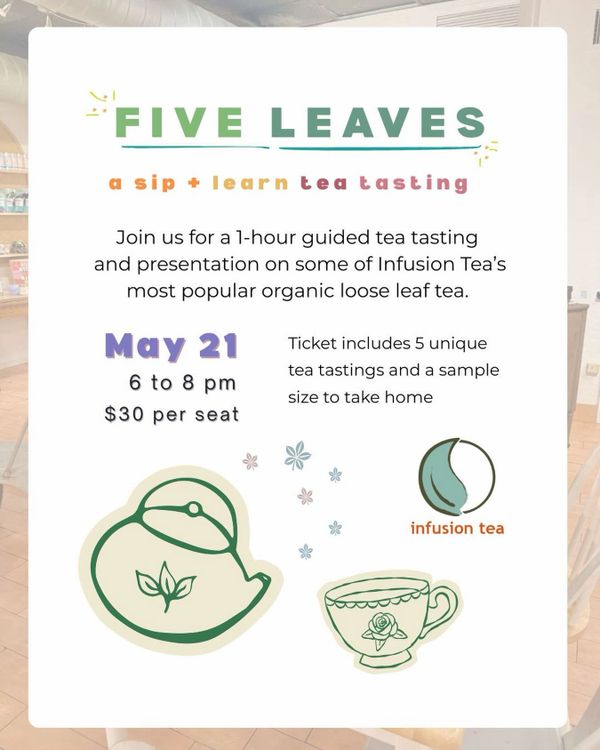
Most Popular Infusion Teas
Blueberry Bliss Black Tea
We’re starting with Blueberry Bliss, which smells a little like somebody baked blueberry muffins nearby but in a classy tea way. It has a rich black tea base with sweet blueberry notes that make it feel cozy and familiar without being overly sweet. This one is super approachable — even people who usually “don’t like tea” tend to suddenly like tea when this is involved. Black tea naturally contains antioxidants and a good little caffeine boost, so this is a great “wake up and participate in society” tea.
⸻
Blackberry Sage Oolong
This Blackberry Sage Oolong is probably the most mysterious tea of the lineup. You get the juicy blackberry right away, and then the sage sneaks in and makes you feel oddly sophisticated for a person sitting in a tea tasting on a Thursday night. The flavor is smooth and layered and changes a little as it cools, which is part of what makes it so fun. It’s fruity, herbal, slightly earthy, and somehow calming at the same time.
⸻
Japanese Popcorn Tea (Genmaicha)
This is Genmaicha, also known as Japanese Popcorn Tea — and yes, every single time we brew it, somebody asks if popcorn is involved. Genmaicha is made by blending Japanese green tea leaves with toasted brown rice, and during the roasting process some of the rice kernels actually pop, which is where the nickname comes from. The green tea is first steamed — which is traditional in Japanese tea processing and helps preserve that fresh green color and vegetal flavor — and then it’s combined with the warm, nutty toasted rice.
The result is this super comforting tea that smells almost like popcorn or toasted cereal and has a mellow, savory flavor that’s very different from grassy green teas people may have tried before. The rice softens the sharper notes of the green tea, so it’s smooth, cozy, and really approachable. It also naturally contains antioxidants from the green tea along with a gentler caffeine level, which makes it a great afternoon tea. Honestly, this one feels like the tea version of comfort food.
⸻
Organic White Ambrosia Tea
This Organic White Ambrosia is soft, delicate, floral, and very peaceful-feeling. It’s made from young tea leaves and buds, and the flavor is much lighter than black or green tea — more subtle and naturally sweet. This is the tea equivalent of somebody quietly opening a window and letting fresh air into the room. White tea is also known for being rich in antioxidants while still being gentle and lower in caffeine. It’s just very pretty and calming from start to finish.
⸻
Weekend in Provence Herbal Blend
And finally, Weekend in Provence — one of our employee favorites because apparently we all want to mentally escape to the south of France. This blend has a smooth rooibos base with lavender, rose, and elderberry, so it smells absolutely incredible while it’s steeping. It’s floral without tasting like perfume, which is a very important distinction. Since it’s naturally caffeine free, this is the kind of tea you drink when you want your nervous system to unclench a little bit. Cozy, fragrant, and honestly just really lovely.
january 29, 2026 tasting menu

Most Popular Infusion Teas
Monk's Blend Black Tea is warm, comforting, and a little mysterious.
- Great example of how a black tea can be robust and elegant at the same time.
- Why? It's flavored, but not perfumey. Balanced, not sugary.
- Traditional European salon tea that dates back to the late 19th century.
- Popular in cafés and salons — places where people lingered, talked, and read.
- Smooth black tea with distinctive notes of vanilla and sweet pomegranate.
Monkey Picked Oolong is legendary, lush and has layers of flavor.
- Refers to style and quality of tea - a high-grade oolong carefully hand-processed.
- According to folklore, trained monkies were sent to pick leaves on steep cliffs of China, too dangerous for humans.
- Meant to be steeped multiple times.
- More flavor emerges each steep.
- Englishman Aeneas Anderson accepted the myth when on the 1793 embassy to China and carried the story home with him to England. It has been handed down ever since in the West.
Dragonwell Green Tea is bright, vegetal, and has nutty elegance.
- Rare and special and one of the most famous green teas from China.
- A green tea for people who say they don't like green tea.
- LongJing is more commonly known as Dragonwell.
- Traditionally pan-fried rather than steamed, makes it less bitter.
- Great for headaches.
- Lower caffeine than black tea. About one quarter caffeine than one cup of coffee.
Silver Needle Strawberry Basil White Tea is delicate, ethereal and rare tasting.
- Strawberry adds a soft, natural sweetness.
- Basil brings a subtle herbal lift - fresh and aromatic.
Winter Mint Rooibos Herbal Tea is cooling, cozy and caffeine-free.
- Rooibos is a South African herb with similar flavor profile as black tea.
- Rich in antioxidants.
- Caffeine free.
- Natually sweet, vanilla-like base.
- Soothing, restorative, grounding.
march 5, 2026 tasting menu
Organic English Breakfast Black Tea
- Fully oxidized - Leaves are withered, rolled and dried and fully oxidized within the production process
- Traditionally sourced from India and Sri Lanka (larger leaves Assam, Darjeeling, Ceylon) outside of China where it originated (smaller leaves)
- Varieties from around the world create different flavor profiles
- English Breakfast is deeper reddish color, has malty notes, and brisk finish
- Heavy palate and clean, slightly tannic edge
- Popularized in the West by traders in the 1800s, leading to widespread cultivation
Candied Watermelon Oolong
- Partially oxidized - Oolong and black tea both come from the same plant, but differ primarily in oxidation levels, resulting in distinct flavors and profiles. Oolong is partially oxidized (8–85%), offering a diverse range from light/floral to roasted/woody. Black tea is fully oxidized (100%), producing a robust, malty, and deep flavor
- Oolong originates from China, means "black dragon"
- It is famously processed using a labor-intensive method involving withering, shaking/tossing to bruise the edges, partial oxidation, pan-firing, and rolling leaves.
- Bright melon notes layered over soft floral base, smooth, round, lingering sweetness
Japanese Popcorn Green Tea
- Least oxidized during processing, hence the name
- Popcorn green tea is blended with brown rice
- It is lightly steamed, preserving its grassy, vegetal character.
- The toasted rice adds warmth and a subtle nuttiness. Together they create a balanced savory-sweet profile.
Organic Silver Needle White Tea
- Made exclusively from young spring buds. It’s minimally processed — simply withered and dried
- Flavor is delicate and layered rather than bold
- Light body and the soft sweetness — often described as honeyed or melon-like
- Delicate
Winter Mint Rooibos Herbal Tea
- Cooling, cozy and caffeine-free
- An herbal infusion from South Africa. (not technically tea)
- Rooibos is naturally smooth with gentle earthy sweetness. Grounded without being heavy, yet strong.
- Infused with cocoa and mint gives strength that can support milk and honey.
april 2nd tasting menu
Luscious Mango Black Tea
- Handpicked Assam Indian tea blended with mango essence for a bold fruit forward experience.
- Black tea is fully oxidized (80-100%) for the fullest flavor and deepest color. Leaves are withered, rolled and dried within the production process
- Varieties from around the world create different flavor profiles. Traditionally sourced from India and Sri Lanka (larger leaves Assam, Darjeeling, Ceylon) outside of China where it originated (smaller leaves)
- Usually has a heavy palate and clean, slightly tannic edge. Robust, malty and deep flavor.
- Bold enough to support milk or cream and sugar
A Very Oolong Engagement
- The perfect blend of lightly fermented Chinese oolong, lavender, rose petals and red clover leaf that is both a mood booster and aphrodisiac.
- Partially oxidized - Oolong and black tea both come from the same plant, but differ primarily in oxidation levels, resulting in distinct flavors and profiles. Oolong is partially oxidized (8–85%), offering a diverse range from light/floral to roasted/woody.
- Oolong originates from China, means "black dragon"
- It is famously processed using a labor-intensive method involving withering, shaking/tossing in bamboo baskets to bruise the edges, partial oxidation, pan-firing, and rolling leaves.
Pineapple Bliss Green Tea
- Least oxidized during processing, hence the name
- Tastes fresh with a hint of pineapple.
- It is lightly steamed, preserving its grassy, vegetal character.
Freestone Orchard White Tea
- Made exclusively from young spring buds. It’s minimally processed — simply withered and dried
- Light body and the soft sweetness — often described as having a gentle burst of orchard citrus.
- Delicate, layered flavor with subtle peach and juicy finish.
Wonder Tummy Herbal Tea
- Calming and caffeine-free digestive herbal infusion
- Settles your stomach using soothing flavors - dandelion, sage and peppermint.